Subscriptions
The subscription management scenario is one
of the key mechanisms for controlling recurring
charges. This is a sensitive area of the product
because subscriptions form ongoing
financial obligations for the user.
In this scenario, the user expects to:
see all active subscriptions
understand future charges
manage services quickly and without unnecessary steps
Any lack of transparency in recurring charges
is directly perceived as a loss of control
over money, even if the system is operating correctly.
→ Key focus: give the user
a sense of complete control over
recurring expenses
Role
Was responsible for the full cycle of redesigning the subscription management
flow: user behavior analysis,
hypothesis formulation,
structure engineering, and interface design
Business task
Increase the transparency of regular charges
and reduce the load on support by improving the subscription management scenario

Product problem
Subscriptions were presented as a set of fragmented elements within the system.
Information about recurring charges was distributed across different screens, which prevented the user from seeing the complete picture.
→ The key problem was the lack of a single subscription management center and a transparent structure of regular expenses
The user was forced to:
find individual charges
determine which subscription they belonged to
navigate to different sections to manage them
This created systemic problems:
loss of control over recurring charges
lack of understanding of active subscriptions
high cognitive and navigational noise
Data (baseline)
users could not accurately determine the full list of active subscriptions
support inquiries were recorded regarding unclear recurring charges
repeated transitions between sections were observed to clarify information
managing subscriptions took several
consecutive steps
Insight
The user perceives subscriptions not as a list of transactions, but as a system of regular commitments:
what is being debited now
what will be debited later
what has already been completed
If this model is not reflected in the interface, the user loses a sense of control
and perceives debits as "random"
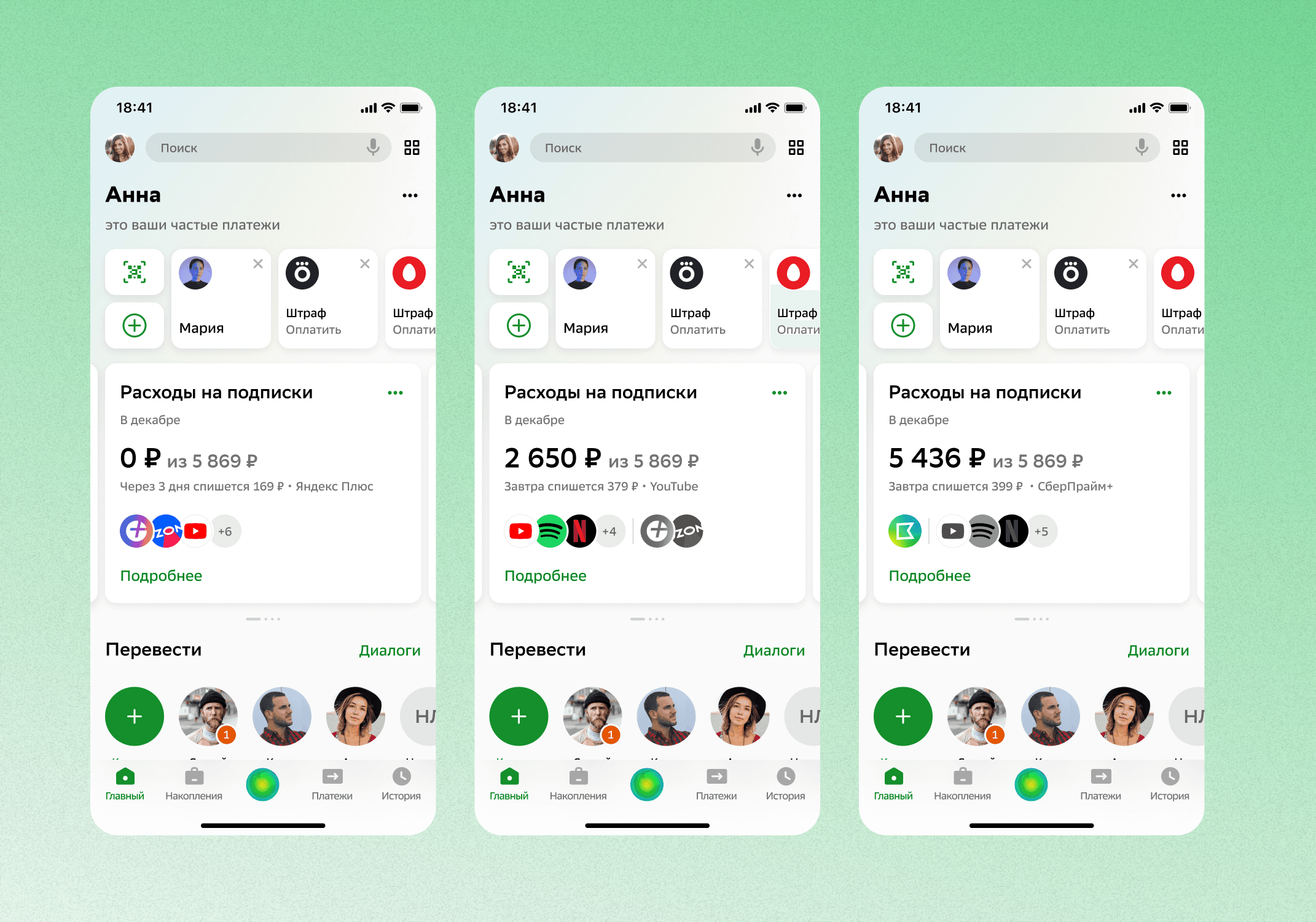
If you combine all subscriptions into a single scenario
and add a temporal context (active / future / completed), the user will start to perceive regular charges as a manageable system rather than a set of separate operations
Hypothesis
All subscriptions have been consolidated into a single screen
with logical grouping:
active subscriptions
future charges
completed payments
→ the user stopped trying to "piece together"
the information and started
to see the full picture of their expenses
Unified subscription screen
Solutions
Added contextual actions
inside subscription cards:
disabling
changing parameters
going to details
→ the user can manage the subscription without switching between screens
Quick actions
List structure
Secondary elements have been removed
information density per line has been reduced
the visual rhythm of the list has been aligned
→ key data can now be read
faster and more consistently
Reducing visual noise
Time context (billing calendar)
Added visualization of regular
charges over time:
dates of future charges
distribution of subscriptions by period
forecast of regular expenses
→ subscriptions have become predictable
and planned.
Since this is a key step of the scenario:
automatic amount
formatting has been added
limits and validation
at the time of entry have been implemented
the likelihood of errors
during entry has been reduced
→ the user completes the most sensitive
step of the operation faster
margins, padding, and visual rhythm have been redesigned
elements are grouped into logical blocks
visual noise density has been reduced
list scannability has been improved
→ information is perceived
in a structured way, rather than as a stream of text
you cannot change the billing logic
it is necessary to preserve all subscription types
the scenario must support different states (active, future, completed)
→ the solution had to be built on the structure and presentation of data, not on changing the business logic
Limitations
The transaction row has been redesigned
to form a clear perception
structure:
the amount is highlighted as the main
visual anchor
the transaction type is grouped with the amount
into a single semantic block
the transaction status is available without
going into details
→ the interface now supports scanning
instead of requiring each line to be read
Each transaction has been redesigned
as a self-sufficient element:
statuses added (completed /
in progress / declined)
short explanations of the operation type added
formatting improved for faster
reading
→ the user gets sufficient
context without the need to
open details
Visual and semantic hierarchy
Context of operations
Solutions
The role of filters was redesigned:
integrated into the main search scenario
simplified application logic
added visual feedback
on active states
reduced cognitive cost
of use
→ filters have become part of the basic scenario,
rather than a separate tool
List structure
Filters
Secondary elements have been removed
information density per line has been reduced
the visual rhythm of the list has been aligned
→ key data can now be read
faster and more consistently
Reducing visual noise
margins, padding, and visual rhythm have been redesigned
elements are grouped into logical blocks
visual noise density has been reduced
list scannability has been improved
→ information is perceived
in a structured way, rather than as a stream of text

I analyzed user behavior
in recurring charge scenarios
and identified a key perception model:
current subscriptions
future charges
completed subscriptions
The problem was not with the data itself, but
that it was scattered and did not form
a single unified picture
Approach
the charge-off logic could not be changed
subscription types could not be removed
future or completed transactions
could not be hidden
→ simplification was achieved through consolidation,
rather than data reduction
Trade-offs
Errors
At an early stage, we considered improving individual interface elements
(notifications, breakdown of charges)
This did not solve the problem because:
the user still did not see the system as a whole
subscriptions remained disjointed
→ conclusion: the problem occurred at the structural level,
rather than at the level of data presentation
subscriptions should be perceived as a system,
not a list of transactions
temporal context is important, not just the fact
of debiting
management should be accessible at the point
of viewing
the user should see the full picture
without searching
Key principles
Results
Secondary elements removed
information density in the row has been reduced
visual rhythm of the list has been aligned
→ key data can now be read faster and more consistently
Reducing visual noise
The role of filters was redesigned:
integrated into the main search scenario
simplified application logic
added visual feedback on active states
reduced cognitive cost of use
→ filters became part of the basic scenario, rather than a separate tool
Filters
Indentations and visual rhythm have been redesigned
elements are grouped into logical blocks
visual noise density is reduced
scannability of the list is improved
→ information is perceived in a structured way rather than as a stream of text
List structure
Each transaction has been redesigned as a self-contained element:
added statuses (completed / processing / declined)
added short explanations of the operation type
improved formatting for faster scanning
→ the user gets sufficient context without the need to open details
Context of operations
The transaction row has been redesigned to form a clear structure of perception:
the amount is highlighted as the main visual anchor
the transaction type is grouped with the amount into a single semantic block
the transaction status is available without going into details
→ the interface now supports scanning instead of requiring reading every line
Visual and semantic hierarchy
Solution design
−23% in support inquiries regarding confusing charges
−31% in time spent completing the subscription management flow
−27% in the number of steps to action (open → change/disable)
−19% in repeat checks of the "subscriptions" section (re-checking statuses)
+24% increase in self-service subscription management without contacting support
The flow became linear:
home screen → subscriptions → action → confirmation
Subscriptions
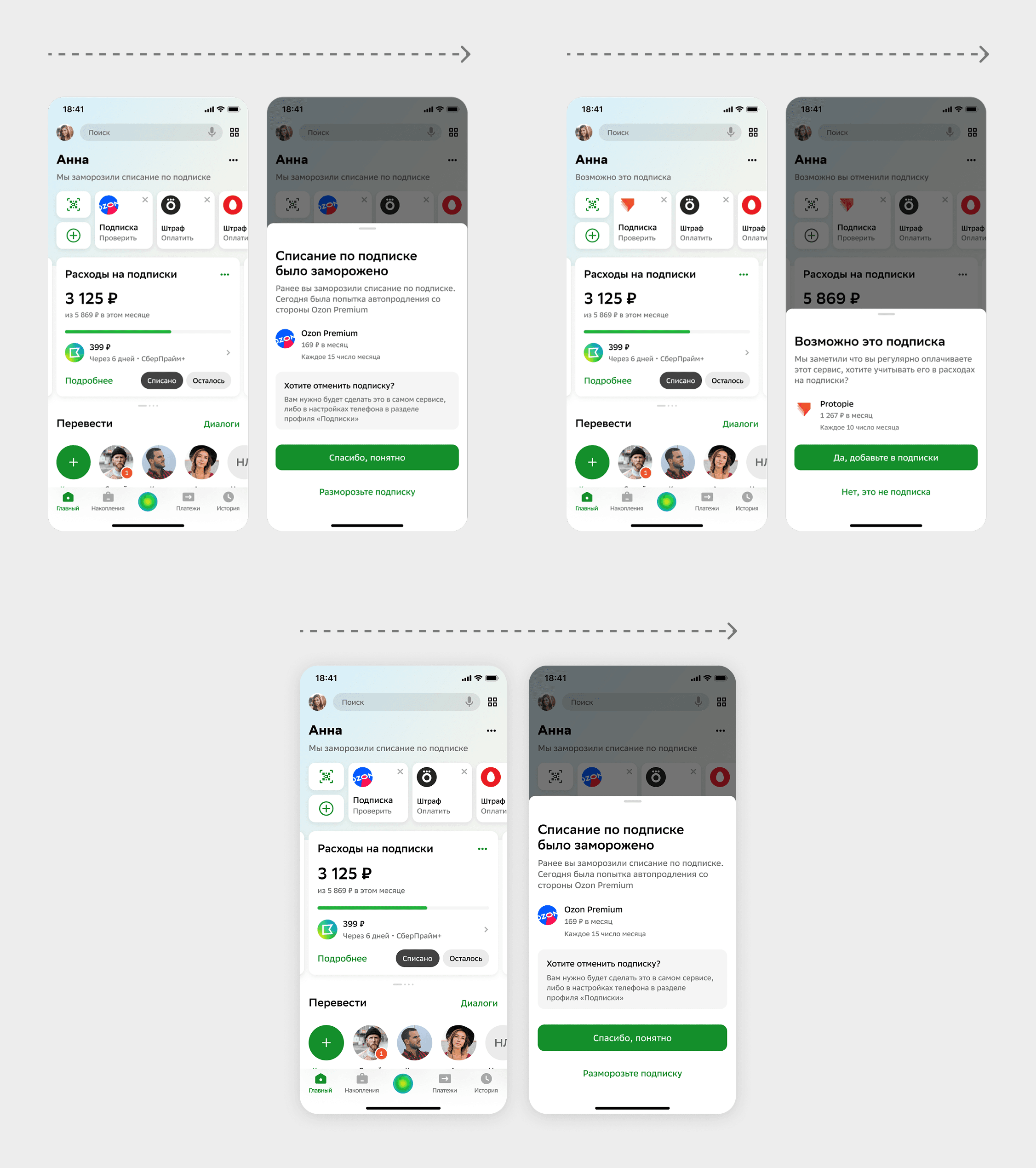
Subscription management interface for viewing active plans, billing data, and renewal dates, helping users control and timely cancel services
Results
— Simplified management of recurring payments
from the main screen, reducing the time to the first
action by 28%
— Reduced the number of steps to view
and manage subscriptions by 35%
— Increased transparency of user expenses, increased views of subscription details
by 22%
— Added quick access to the details of each subscription, which increased transitions
to detail screens by 19%
— Improved navigation between subscriptions
and actions, reducing navigation errors by 24%
— Visually separated active, upcoming
and past payments, which reduced erroneous clicks by 27%
— Reduced cognitive load when working
with financial data, reducing task execution time by 21%
Task
In the app, users found it
difficult to track subscriptions and recurring charges. Payment information was scattered across different screens,
and viewing and managing subscriptions required too many steps
Solution
Designed a new user scenario for managing subscriptions within the banking app. Redesigned the main subscription expenses block, added a payment calendar, subscription cards, and a separate screen for managing active services
Process
— Analyzed user scenarios for managing subscriptions
— Identified problems in the current interface structure
— Designed a new UX logic for displaying subscription expenses
— Developed the structure of the subscription block
on the main screen
— Created a payment calendar to visualize recurring payments
— Designed subscription cards
with quick access to management
— Developed subscription detail screens
— Added scenarios for editing
and managing each subscription
Subscriptions
The subscription scenario helps users to:
control regular deductions
manage recurring payments
track active services
understand the structure of monthly expenses
quickly interact with subscriptions
Despite the demand for this scenario, the existing UX created
difficulties when managing recurring payments
Role
Was responsible for the full cycle of redesigning the transaction history scenario: analyzing user behavior, formulating hypotheses, designing the solution, and interface design.
UX audit of the current solution
discovery and analysis of user scenarios
research recurring payment behavior
formulation of UX hypotheses
redesign mobile experience
designing the payment management flow
creation of the UI concept
Area of responsibility:


Product problem
Subscriptions were one of the most complex financial scenarios within the product.
regular charges
shared expenses
group payments
subscription statuses
member management
payment actions
cognitive overload
navigation complexity
poor predictability
lack of spending transparency
difficulty in controlling recurring payments
The interface combined:
Due to the high density of features, users faced:
Project goals
1. Business Goals
2. Product goals
3. UX Goals
increase user engagement
increase the use of recurring payment features
boost trust in financial transactions
reduce the number of problematic payment scenarios
simplify subscription management
increase transparency of recurring expenses
improve interface scanability
reduce friction within the payment flow
speed up key actions
reduce cognitive overload
strengthen visual hierarchy
make recurring payments more predictable
simplify navigation flow
_________________________________________________________________________________________________________________________
_________________________________________________________________________________________________________________________
Research
/ UX Audit:
Allowed to identify problems in navigation, visual hierarchy, and interface structure
/ User scenario analysis:
Helped define the main actions within the transaction history section
/ Competitive research:
Solutions of banking and fintech products were studied to compare approaches
to filtering, searching, and displaying transactions
/ Interviews and feedback:
Recurring user issues
and behavior patterns were analyzed
What was important to understand
Before starting the design, it was important to determine:
how users perceive recurring expenses
what scenarios cause confusion
where users lose control over subscriptions
what actions are the most frequent
what interface elements create overload
Methods Used
1. UX audit
2. Competitive research
3. User scenario analysis
4. User behavior analysis
Allowed me to identify issues with visual hierarchy and navigation flow
Fintech and subscription-management products were studied for analysis:
regular payments
shared expense scenarios
subscription management dashboards
mobile management scenarios
Helped identify the most frequent actions and friction points
It allowed for the identification of recurring issues with subscription management and recurring expenses
___________________________________________________________________________________________________________
___________________________________________________________________________________________________________
___________________________________________________________________________________________________________
Key observations
1. Users had a poor understanding of the recurring expenses structure
Important actions were lost within the interface
3. Users were afraid of unexpected charges
Most users could not quickly determine:
Due to the lack of a clear visual hierarchy, important data was lost among secondary information
which subscriptions are active
when the next charge will occur
how much money is spent monthly
CTA and payment actions computed with a large amount of
secondary information
Insufficient transparency of recurring payments reduced trust in the scenario
___________________________________________________________________________________________________________
___________________________________________________________________________________________________________

JTBD
When
I want to quickly see active recurring payments
I want to understand the payment statuses and participant actions
I want to manage subscriptions in the minimum number of actions
When I interact with a group subscription
When I use the mobile application
To control your monthly expenses
To avoid confusion within the payment flow
So as not to waste extra time on navigation
I manage subscriptions
___________________________________________________________________________________________________________
___________________________________________________________________________________________________________
Hypotheses
Hypothesis 1
Hypothesis 2
Hypothesis 3
Why we calculated it this way:
If you make regular expenses more transparent,
users will have better control over their subscriptions.
Why we calculated it this way:
users did not understand the structure of recurring charges
it was difficult to quickly see active subscriptions
the date of the next charge was not perceived as prominent enough
users lost control over monthly expenses
CTAs were lost among secondary information
important actions lacked sufficient visual priority
the interface looked cluttered
users spent more time on scanability
the scenario contained unnecessary steps
navigation flow was not predictable enough
users took longer to perform basic actions
the mobile scenario created additional friction
If you strengthen the visual hierarchy, users will perceive key actions faster
Why we calculated it this way:
If you reduce the number of actions within the scenario,
subscription management will become simpler and faster
___________________________________________________________________________________________________________
___________________________________________________________________________________________________________

Iterations
First concept
What the review showed
In the final decision
Initially, the interface contained more analytics and additional statuses.
This made the scenario more informative, but visually overloaded the interface.
During the analysis, it became clear that users lose focus and spend too much time on the scanability of recurring payments.
recurring payments have become visually clearer;
CTAs have been given higher priority;
the flow has become simpler;
the interface has become easier to perceive.
___________________________________________________________________________________________________________
___________________________________________________________________________________________________________
UX solutions
1. Improving the transparency of recurring payments
3. Strengthening the visual hierarchy
4. Mobile UX Optimization
2. Simplifying the payment flow
active subscriptions
date of next charge
amount of expenses
payment status
higher visual priority
improved scanability
more predictable structure
touch interactions have been improved
the number of steps has been reduced
readability of recurring payments has been enhanced
navigation within the flow has been improved
unnecessary actions
visual noise
repetitive scenarios
The user now understands faster:
CTAs and key actions received:
In the mobile version:
The following were reduced:
___________________________________________________________________________________________________________
___________________________________________________________________________________________________________
___________________________________________________________________________________________________________

Trades off
During the design process, it was important to maintain a balance between:
As a result:
number of functions
transparency of information
simplicity of the interface
secondary information has been simplified
key actions have been given higher priority
recurring payments have been visually structured
Initially, the option of displaying the maximum
amount of analytics and statuses on the main screen was considered. However, this approach
overloaded the interface and worsened scanability
Efficiency assessment
After the redesign, the main focus was on:
subscription management speed
completion rate
error rate
user engagement
scenarios execution time
Results
+22% completion rate
−28% payment errors
+18% engagement
−30% scenario time
Mobile UX improvement
Review
helps control regular debits
reduces financial uncertainty
simplifies the management of recurring payments
accelerates interaction with key actions
makes financial operations more predictable
Special attention was paid to visual hierarchy, transparency of recurring expenses, and reducing cognitive overload within the payment flow
The project was aimed at creating a convenient and transparent experience
for managing subscriptions and recurring expenses.
The main task was not just to design the subscription interface,
but to build a clear user scenario that: